
Stronger business owners build stronger businesses.
Support for business owners who want clarity, confidence and stronger foundations
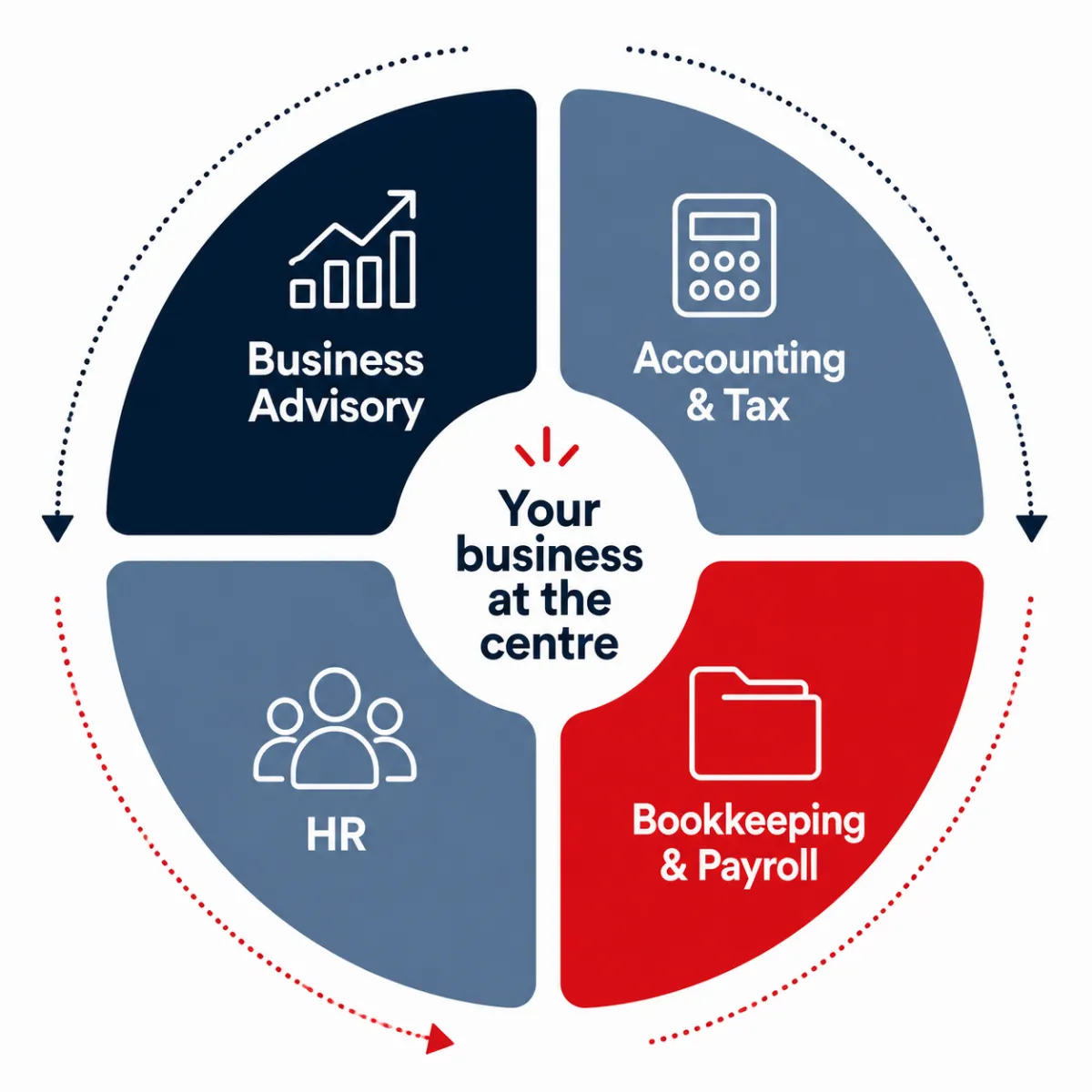
Running a business can get complicated quickly. MBK connects your people, numbers, systems and strategy so you can make better decisions with confidence — with the right support around you across Business Advisory, Tax Accounting, HR, and Bookkeeping & Payroll.

Stronger business owners build stronger businesses.
Support for business owners who want clarity, confidence and stronger foundations
Running a business can get complicated quickly. MBK connects your people, numbers, systems and strategy so you can make better decisions with confidence — with the right support around you across Business Advisory, Tax Accounting, HR, and Bookkeeping & Payroll.
Has your business outgrown the way you've been doing things?
What worked when the business was smaller does not always keep working as it grows.
You may have more people, more moving parts and more decisions to make — without the systems, information or support around you keeping pace.
Sometimes the issue is obvious. Sometimes it is simply a sense that things could be clearer, stronger or easier to manage.
You do not need to wait until something is broken before asking for help.

Ready to move beyond DIY

Working with information you don't full trust
Dealing with disconnected people, finances or systems
Wanting experiences support before something becomes a bigger issue
Ready to move beyond DIY
Working with information you don't full trust
Dealing with disconnected people, finances or systems
Wanting experiences support before something becomes a bigger issue
Our role is not to run your business for you. It is to help you become stronger at leading it.
what is a business keeper?
A Business Keeper helps you see the whole picture.
A strong business needs more than good bookkeeping, sound HR or the right tax advice in isolation.
A Business Keeper looks across the business — people, finance, systems, compliance and strategy — and helps connect what is happening in each area.
We ask the questions that need to be asked, help create clarity and strengthen the foundations around you so you can make better decisions with confidence.
Everything in your business is connected. Your support should be too.
Four Pillars of Service

Business Advisory
Make better decisions with clearer information.
Get practical support around budgets, cash flow, profitability, forecasting and business performance, so you can understand what the numbers are telling you and make more confident decisions about what comes next.
Tax Accounting
Keep the financial foundations of your business strong.
From tax and compliance to financial reporting and ongoing accounting support, we help you stay on top of your obligations and understand the financial position of your business more clearly.

HR
Build a stronger, more capable team.
Get practical HR support for the real people issues that come with running a business — from employment documentation and performance management to workplace matters, compliance and ongoing HR guidance.

Bookkeeping & Payroll
Know your numbers
are right.
Reliable bookkeeping and payroll give you accurate information, stronger systems and greater confidence in the day-to-day financial workings of your business.
Business Advisory
Make better decisions with clearer information.
Get practical support around budgets, cash flow, profitability, forecasting and business performance, so you can understand what the numbers are telling you and make more confident decisions about what comes next.
Tax Accounting
Keep the financial foundations of your business strong.
From tax and compliance to financial reporting and ongoing accounting support, we help you stay on top of your obligations and understand the financial position of your business more clearly.
HR
Build a stronger, more capable team.
Get practical HR support for the real people issues that come with running a business — from employment documentation and performance management to workplace matters, compliance and ongoing HR guidance.
Bookkeeping & Payroll
Know your numbers
are right.
Reliable bookkeeping and payroll give you accurate information, stronger systems and greater confidence in the day-to-day financial workings of your business.
Not sure which service fits?
Start with Booking a Call and we’ll help you work out the right place to begin.
why businesses choose mbk
The right support,
when your business needs more around it
MBK works with business owners at different stages — from getting the foundations right to managing the complexity that comes with growth.
You may have outgrown DIY, inherited systems that are not working well, need more confidence in your numbers or people decisions, or simply want experienced support around you.
What makes MBK different is that you are supported by a connected team with shared knowledge, strong systems and practical expertise across the business.
Connected expertise
Qualified professionals
Team-based support
Practical advice
Capability, not dependence

why businesses choose mbk
The right support,
when your business needs more around it
MBK works with business owners at different stages — from getting the foundations right to managing the complexity that comes with growth.
You may have outgrown DIY, inherited systems that are not working well, need more confidence in your numbers or people decisions, or simply want experienced support around you.
What makes MBK different is that you are supported by a connected team with shared knowledge, strong systems and practical expertise across the business.
Connected expertise
Qualified professionals
Team-based support
Practical advice
Capability, not dependence
testimonials
What it feels like to have the right support around you
The difference in the service provided by Pauline and the MBK team is very clear compared to other bookkeepers. Each member within the team has been so pleasant to communicate with and have gone over and above to help and guide us.

My business wouldn’t be running without the help of everyone at MBK. They all work so hard to see their clients succeed. I am so thankful to be working with them on my business journey!

Amy as a person, and the values and personality that she brings to her work and her company, are what made working with her such a revolutionary and delightful experience. I trust her, her professional experience and business acumen immensely and she was able to help our small company to be compliant, and competent in the HR space but maintain our family feel. I cannot recommend her enough.


not sure where to start
Book a Mini Consultation
Book a 30 minute consult with Pauline or Amy to have your burning questions answered for just $99.
Got Financial Questions?
Got People Questions?
not sure where to start
Book a Mini Consultation
Book a 30 minute consult with Pauline or Amy to have your burning questions answered for just $99.
Got Financial Questions?
Got People Questions?
latest insights
Blog Title Here

Profitable But No Cash? 3 Financial Reports You Need
Your business has had a busy month. Sales are coming in, your profit and loss statement shows a positive result, and from the outside, everything appears to be moving in the right direction.
Yet when you check the bank account, there isn't nearly as much money available as you expected.
It's a familiar question for many Australian business owners: How can my business be profitable when there isn't enough cash in the bank?
The answer often sits in the difference between profit, financial position and cash flow.
Understanding those differences helps you make more informed decisions about your business, particularly when you're considering new employees, equipment, premises or future growth.
Why profit doesn't always mean cash in the bank
Your profit and loss statement shows the financial performance of your business over a particular period.
It records revenue and expenses according to the accounting method being used. Depending on that method, revenue may appear before a customer has paid, while certain payments leaving your bank account may not appear as expenses in the same way.
For example, you might have:
Issued invoices that customers haven't paid yet.
GST and other liabilities that will need to be paid.
Loan repayments requiring cash, including principal repayments that aren't operating expenses.
Equipment purchases or other investments affecting your cash balance.
Upcoming payroll and superannuation commitments.
A business can therefore report a profit while still experiencing cash flow pressure.
The challenge is understanding where the money has gone, what is already committed and what is likely to happen next.
This is where three financial reports become particularly useful.
1. Profit and loss statement: How is your business performing?
Your profit and loss statement, sometimes called a P&L, shows the revenue earned and expenses incurred over a defined period.
It helps you understand whether the business is operating profitably and where its income is being spent.
Three figures are particularly useful to understand.
Revenue is the income generated by your business.
Gross profit is the amount remaining after deducting the direct costs associated with providing your products or services.
Net profit is the result after accounting for relevant operating expenses and other items included in the report.
Understanding these figures helps you ask better questions.
Are your direct costs increasing faster than your sales? Are wages and other operating expenses taking up a greater percentage of revenue? Is increased business activity actually improving profitability?
We often encourages business owners to consider the story behind their reports, including what each expense represents as a proportion of income.
Comparing figures over time can reveal changes that might be difficult to recognise from a single month's result.
The profit and loss statement is an important starting point, although there is more information to consider before making a significant financial decision.
2. Balance sheet: What does your business own and owe?
The balance sheet shows the financial position of your business at a particular point in time.
It brings together three main elements:
Assets: What the business owns or controls, including cash, amounts owed by customers, equipment and other relevant business assets.
Liabilities: What the business owes, such as loans, unpaid supplier accounts, tax obligations and other financial commitments.
Equity: The remaining interest in the business after liabilities have been deducted from assets.
Imagine checking your business bank account and seeing a healthy balance.
That money may look available, but some of it could be needed to cover GST, employee-related obligations, supplier invoices or upcoming loan repayments.
Your balance sheet helps you understand those existing obligations alongside your assets.
It also provides context that your profit and loss statement cannot show on its own.
For business owners who have never spent much time reviewing their balance sheet, a useful starting point is to go through the report line by line and ask what each figure represents.
You should be able to understand what the business owns, what it owes and how those amounts have changed.
If something doesn't make sense, that's a worthwhile question to raise with your accountant, bookkeeper or business adviser.
3. Cash flow forecast: When will money actually move?
Your cash flow forecast considers the timing of money coming into and leaving the business.
This is particularly important because bills and financial obligations don't necessarily arrive at the same time as customer payments.
For example, your business might have several significant invoices expected to be paid next month, while employee wages, supplier payments and tax obligations fall due this week.
A cash flow forecast can help you understand whether there is enough money available to meet those commitments.
A useful forecast considers factors such as:
Expected customer payments and their likely timing.
Supplier and operating expenses.
Employee wages and superannuation.
GST and other tax payments.
Loan repayments.
Planned investments or significant purchases.
Seasonal changes in trading activity.
The forecast should also be reviewed and updated as circumstances change.
A projection is only as useful as the assumptions and information behind it.
When combined with your profit and loss statement and balance sheet, cash flow forecasting gives you a clearer picture of where the business has been, where it currently stands and what may happen next.
How these three reports support better business decisions
Consider a business owner who wants to employ another person.
The business is busy, customers are waiting and the owner believes another employee would help meet demand.
It's a reasonable idea, but the financial decision deserves closer attention.
The profit and loss statement can help them understand the profitability of the current business model.
The balance sheet can reveal existing liabilities, available assets and the broader financial position.
A cash flow forecast can help them consider when additional wage costs, superannuation and other employment expenses will need to be paid, and whether the business is likely to have sufficient funds available.
The owner can then consider questions such as:
Will another employee generate enough additional revenue to support the cost?
How long might it take before the additional capacity translates into income?
What happens if expected customer payments arrive later than anticipated?
What existing financial obligations need to be considered?
How might this decision affect the business over the next three to six months?
There are also HR, payroll and operational considerations to work through.
This is why business decisions benefit from looking beyond one report or one area of professional expertise.
What if you don't understand your financial reports?
You don't need to become an accountant to understand the financial position of your business.
You do, however, benefit from understanding what your reports are telling you and being able to ask questions when something isn't clear.
During a recent MBK conversation, Amy reflected on her experience of running her own business.
In the early years, her main financial measures were whether she could pay her bills and pay herself. Over time, she developed a deeper understanding of what her business numbers could tell her about planning and financial decisions.
It's an experience many business owners can relate to.
Understanding your reports is something you can learn, particularly when you have professionals who are willing to explain the information in plain English.
A useful place to begin is by asking:
What is our business actually earning after expenses?
What money do we owe, and when will those amounts need to be paid?
What money is owed to us, and when do we expect to receive it?
What does our cash position look like over the coming months?
What do these figures mean for the next decision we're considering?
If your financial information doesn't give you clear answers, you may need to review the records, reporting processes or assumptions behind it.
Know Your Numbers: Turning financial information into practical decisions
At My Business Keeper, we believe stronger business owners build stronger businesses.
A significant part of that is helping owners understand their numbers and make more informed decisions.
Our Know Your Numbers services connect financial analysis with practical business considerations, including profitability, cash flow, forecasting, investment and growth.
We can also draw on MBK's wider expertise across accounting, bookkeeping, payroll and HR where those areas affect the decision you're working through.
If your business is showing a profit but you're still unsure where the money is going, or you're considering an important financial decision, it may be time to look at the bigger picture.
Explore Know Your Numbers at My Business Keeper and start a conversation about what your numbers are telling you.
This article provides general information and does not take into account your individual business circumstances. Seek professional advice relevant to your situation.

Stay in the loop

services
company
get in touch
FOLLOW US


© Copyright 2026. My Business Keeper. All Rights Reserved.
View our Privacy Policy and Terms and Conditions here.